I design cloud products people can actually operate.
Five years turning dense infrastructure into interfaces engineers trust — and building the teams that keep them that way.

Currently
Leading design for parspack — the control panel, billing and identity surfaces behind a national cloud platform.
Trusted with the work at


Selected work
Products I shaped end to end — the problem, the calls I made, what shipped. The rest are being written up.
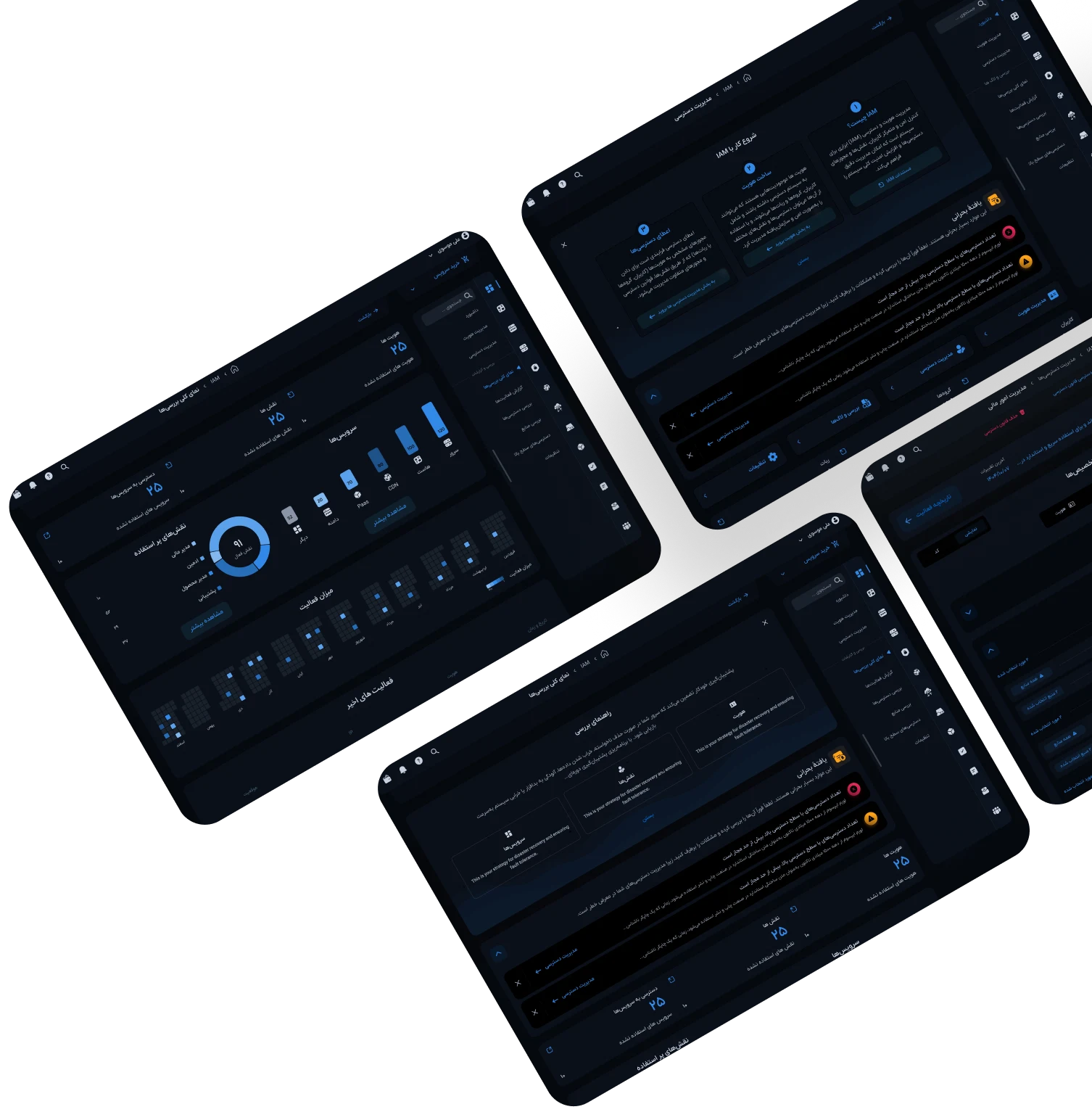
Leadership
What I actually changed when I stopped being the one pushing every pixel.
3→9
designers led
grown over two years without losing anyone I wanted to keep
6
squads on one design system
adoption by pull, not mandate
40%
faster design → merged
4
hires made
0 regretted
I inherited three designers covering fourteen product teams, which meant everybody was a service desk and nobody owned an outcome. The fix was not more headcount first — it was deciding what a designer here is accountable for, then hiring against that.
I wrote the loop we still use: portfolio screen, a paid craft exercise on a real (declassified) problem, a working session with the squad they would join, and a leadership conversation about how they handle disagreement. No whiteboard trivia.
Hiring loop — scoring rubricartifact - 01 Frames the problem before proposing a solution
- 02 Names the trade-off they rejected, and why
- 03 Craft holds up at 400% zoom and at arm's length
- 04 Handles a direct challenge without defending or folding
- 05 Leaves the room with the work further along
The rubric interviewers score against. Every line is observable behaviour.
A system nobody adopts is a hobby. We shipped only the twelve components that appeared in every product, then let demand pull the rest — and published a deprecation calendar so teams could plan instead of being surprised.
Governance is a biweekly council, not a queue. Anyone can contribute; the council decides what becomes canonical and what gets deprecated, in public, with the reasoning written down.
Design system council — standing agendaartifact - 05' Adoption dashboard — who is on what version
- 10' Contributions up for promotion to canonical
- 10' Deprecations and their migration window
- 05' Bar check — one shipped screen, reviewed live
30 minutes, biweekly. If it needs longer, it needed a document first.
Quality does not survive on taste alone; it survives on a repeatable room. Critique here is weekly, timeboxed, and structured so the most senior person speaks last — otherwise the loudest opinion becomes the decision.
The presenter states the decision they need. Feedback that does not serve that decision gets written down for later instead of derailing the session.
Critique formatartifact - 1 Context — who is this for, what changed since last time
- 2 The decision I need from you today
- 3 Silent read, 3 minutes, no narration
- 4 Questions before opinions
- 5 Opinions, most senior voice last
- 6 Presenter restates what they are changing
Same six steps every week. Predictability is what makes people bring risky work.
Most design failures here were not craft failures — they were sequencing failures. Design arrived after the commitment was made, so the only available moves were cosmetic.
I moved design into the shaping phase: a designer sits in the problem definition and leaves with the same understanding of constraints as the engineers. In exchange, we commit to a scope we can actually finish.
Shaping handshakeartifact - Design brings the user problem, the failure modes, the riskiest flow
- Eng brings the cost of each approach, in weeks, honestly
- Together one scope both sides will defend in the review
- Nobody brings a solution nobody has priced
What design and engineering owe each other before a phase is committed.
The practice
How the work gets made — the parts that survive a change of company.
Turning a vague ambition into a sequence someone can actually build — what ships first, what it proves, and what we are willing to be wrong about.
Infrastructure products fail at the moment of comprehension. I design for the operator under pressure, not the screenshot in the pitch deck.
Tokens, components, governance and a deprecation calendar. Adoption measured, not assumed.
Support tickets, session recordings and twelve honest customer conversations beat a hundred survey responses. I run the ones that change the roadmap.
Hiring loops, levelling, growth plans and the weekly critique that holds the bar. Designers here leave better than they arrived.
I prototype in the real stack. Handoff arguments mostly disappear when the thing being argued about already runs.
How I work
Four moves, in order, every time.
Frame
Find the real problem and write it down in one sentence everybody signs.
Explore
Cheap, wide, ugly. Enough options that the choice is informed rather than first-found.
Build
Prototype in the real stack, test with real operators, cut what does not earn its place.
Hold
Ship, measure against the baseline we took beforehand, and keep the bar after launch.
Toolkit
Where the hours went.
Figma
Design, systems, variables
Design systems
Tokens, governance, adoption
Research & testing
Interviews, usability, tickets
Next.js & React
Prototypes that really run
Framer & Webflow
Marketing surfaces, fast
n8n & automation
Ops glue for the team
Track record
Ten years, from architecture school to a cloud platform's design team.
5
years — designing, most of it in infrastructure
- Aug 2023 — nowLead Product Designerparspack
- Jul — Aug 2025Product DesignerAlgorockcontract
- 2024 — 2025Product DesignerModeliccontract
- 2023 — 2024Product DesignerRamzArzcontract
- 2023Product DesignerDehkade Bazicontract
- Feb 2022 — Jun 2023Product DesignerMoj Secure E-Commerce
- 2020 — 2023Freelance Product DesignerIndependentcontract
95%
client satisfaction
built on trust and results
Words from clients
People who shipped with me.
“Ali is the first designer here who argued with engineering about cost and won on the merits. The panel rebuild happened because he made it measurable.”
“He turned a three-person service desk into a team with actual ownership. Two of the people he hired are now running their own surfaces.”
“Fastest I have ever gone from a fuzzy brief to something clickable. He prototypes in the real stack, so what we discussed on Monday was running by Thursday.”
Built on the side
Nights and weekends. Shipped, not pitched.
